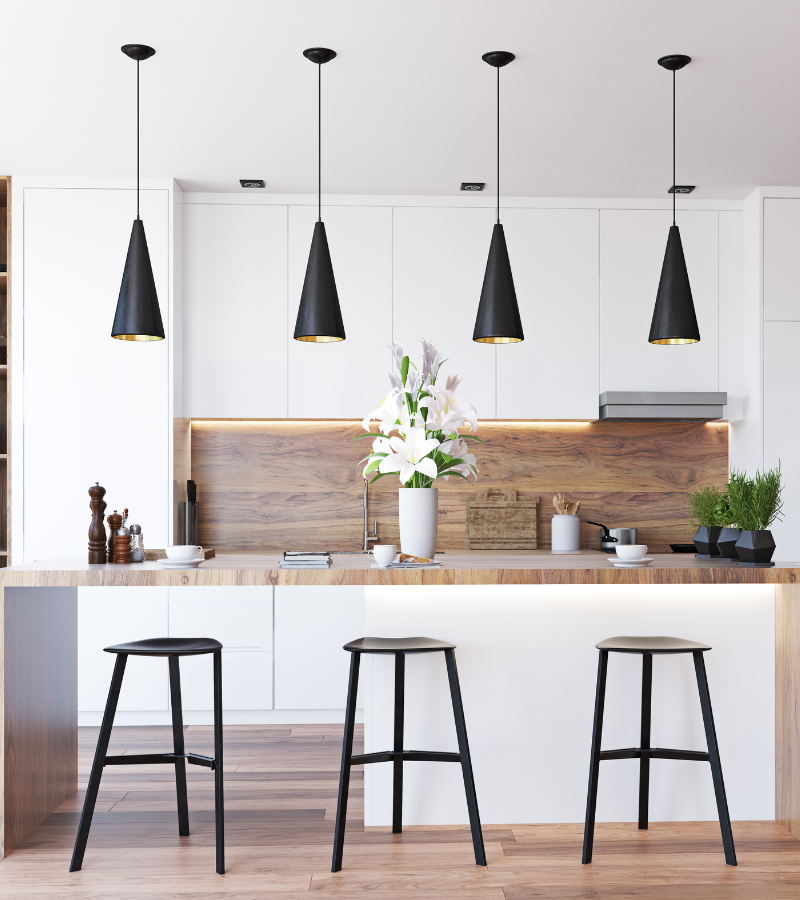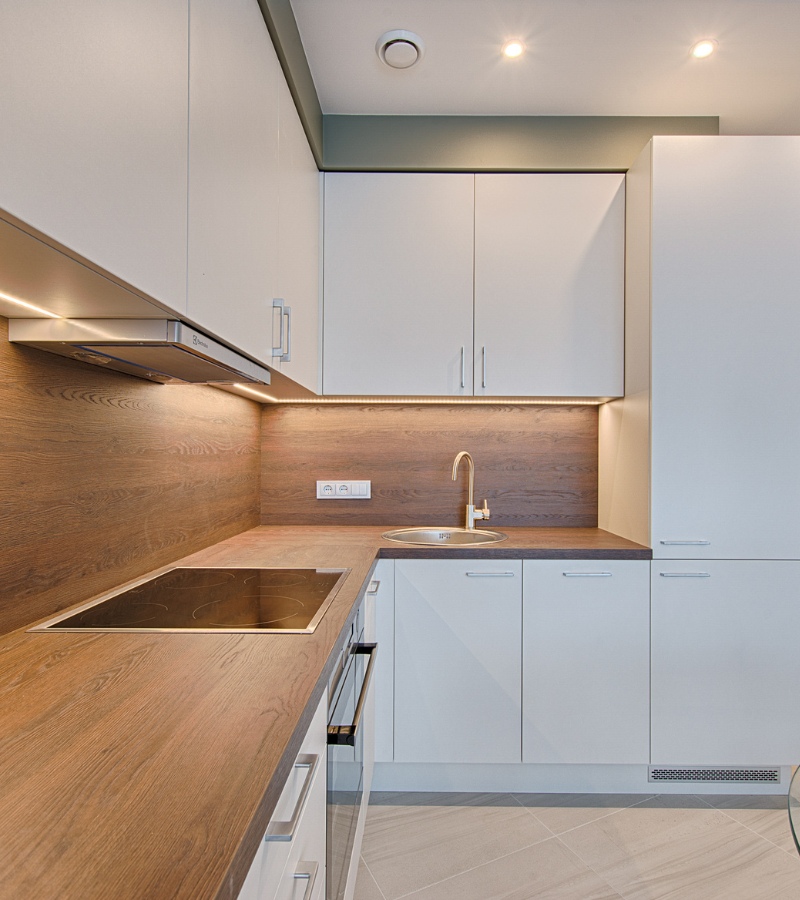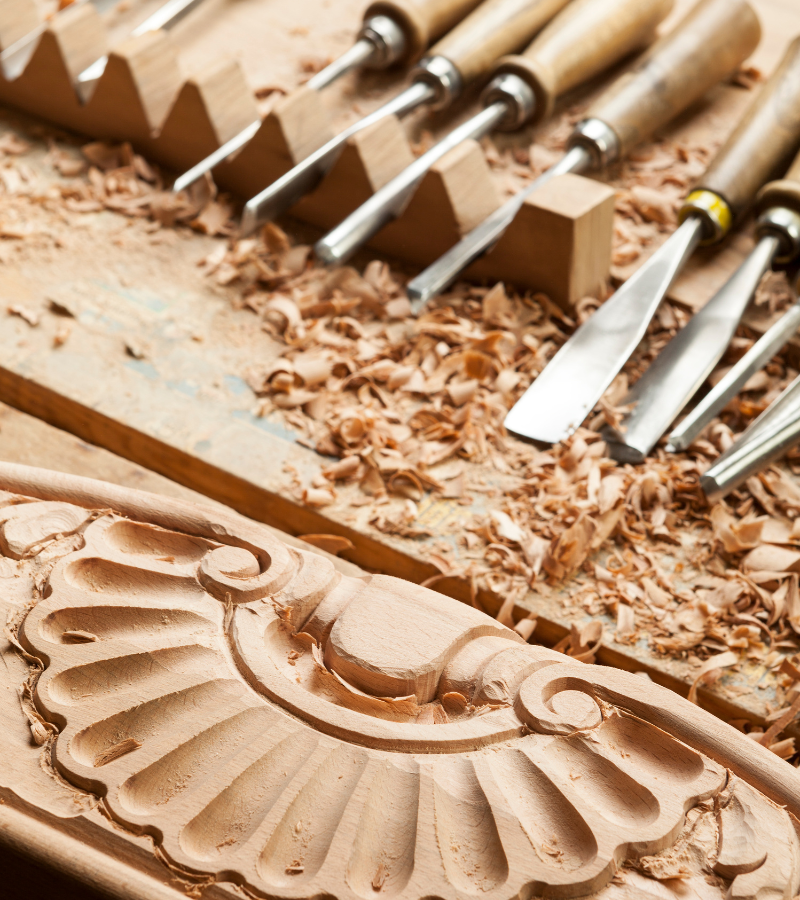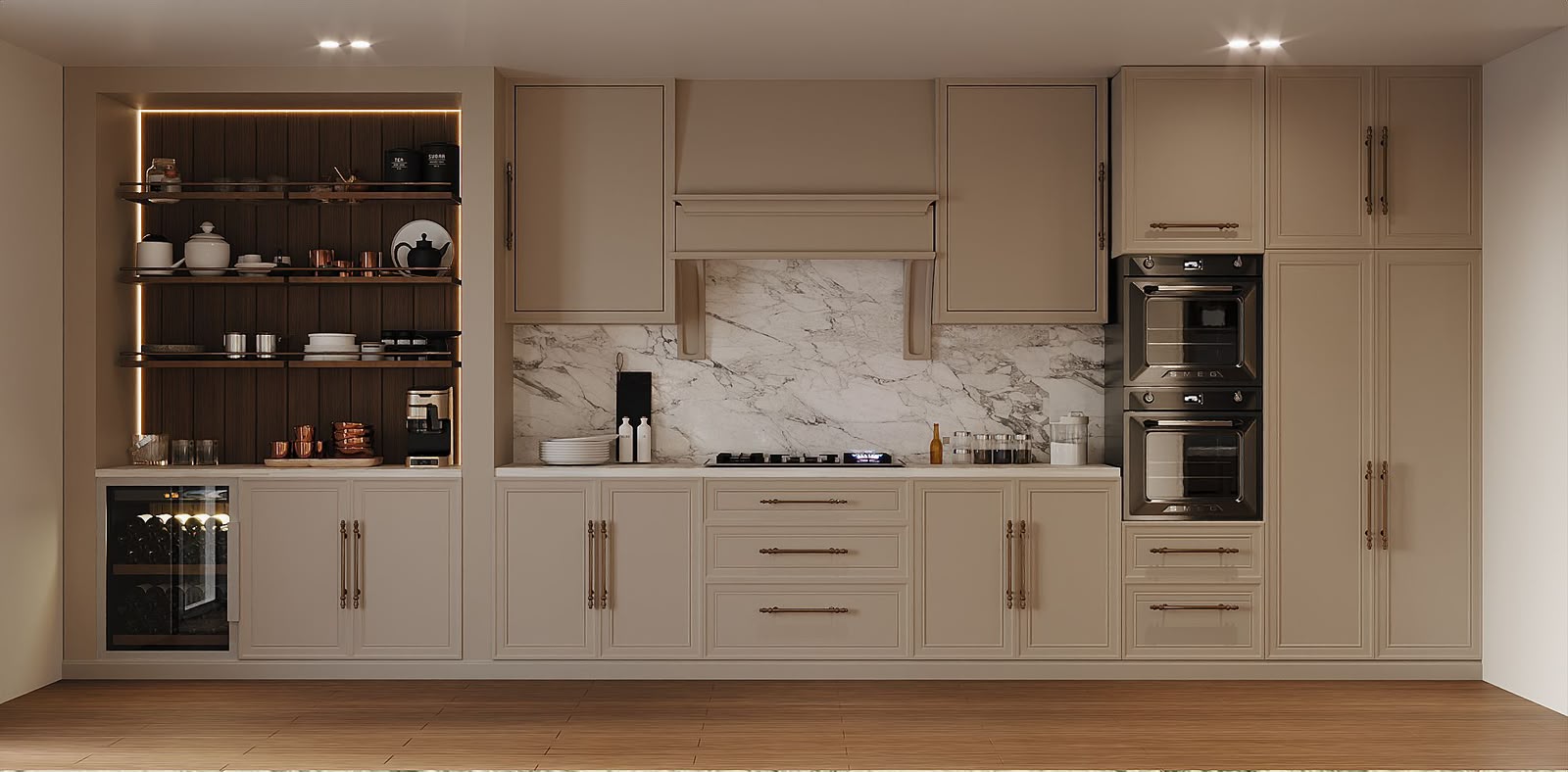
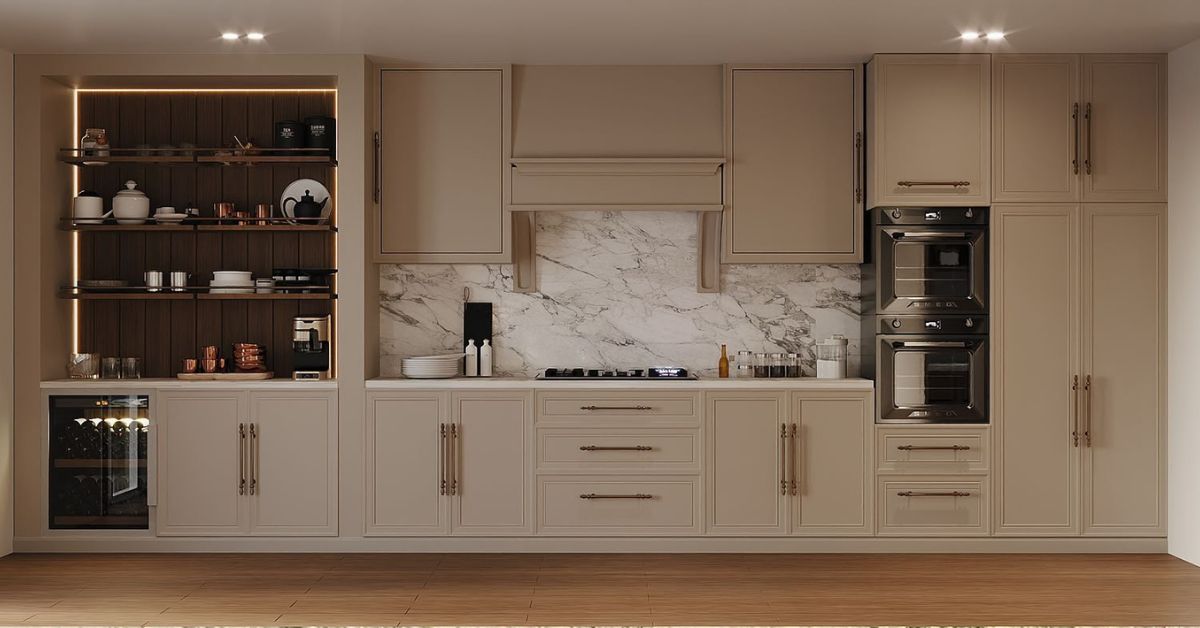
Selecting the right Kitchen Cabinet Materials in Dubai helps create cabinetry that balances durability, appearance, maintenance and everyday functionality.
Choosing the right Kitchen Cabinet Materials in Dubai is one of the most important decisions in a kitchen renovation or fit-out. Cabinetry occupies a large portion of the kitchen, influences its overall appearance and must withstand daily opening, cleaning, storage loads, cooking heat and occasional moisture.
MDF, plywood, veneer and solid wood are often discussed as though they are interchangeable materials. However, they perform different roles. MDF and plywood are commonly used as core boards, veneer is usually a decorative surface applied over another material, and solid wood may be used for doors, frames or selected details.
The correct choice depends on more than appearance. Homeowners should consider where the material will be installed, how frequently the kitchen is used, the chosen finish, maintenance expectations and the quality of fabrication.
These factors are particularly relevant for homes in Dubai, Sharjah and across the UAE, where kitchens may experience continuous air-conditioning, high external temperatures, cooking steam and occasional humidity. This guide compares the main kitchen cabinet materials and explains how to choose an appropriate combination for your home.
Why Kitchen Cabinet Material Selection Matters
Kitchen cabinets are expected to perform several functions at the same time. They must support worktops, hold cookware, conceal appliances and remain aligned despite frequent use.
A cabinet may look attractive when newly installed but develop problems when the core material, edge sealing or hardware is unsuitable for its application. Common issues include swollen edges, loose hinges, sagging shelves, peeling finishes and doors that become misaligned.
The cabinet material influences:
- Structural strength
- Resistance to occasional moisture
- Screw-holding performance
- Surface smoothness
- Finish options
- Maintenance requirements
- Ability to create decorative details
- Long-term appearance
No single material is automatically suitable for every cabinet component. A practical kitchen may use one material for carcasses, another for doors and a decorative veneer or laminate for the visible finish.
Understanding these differences helps homeowners make informed decisions rather than selecting cabinets only by colour or appearance.
Understand the Main Parts of a Kitchen Cabinet
Before comparing materials, it is useful to understand how kitchen cabinets are constructed. Different parts of the cabinet face different levels of wear, weight and moisture exposure.
Cabinet Carcass
The carcass is the internal cabinet box. It includes the sides, base, top, back and internal shelves. The carcass supports stored items and provides the structure to which doors, drawers and hardware are attached.
Cabinet Doors and Drawer Fronts
Doors and drawer fronts are the most visible parts of the cabinetry. They determine much of the kitchen’s style and are frequently touched, cleaned and opened.
Shelves and Drawers
Shelves must support the weight of crockery, cookware, food and appliances. Drawers also require strong joints and suitable runners, particularly when they hold heavy pots or plates.
Back Panels
Back panels help stabilise cabinets and conceal the wall. They should be properly fitted rather than treated as an unimportant component.
Edges and Finishes
The core board is usually covered with laminate, paint, veneer or another finish. Exposed edges must be sealed or finished carefully to protect the board and create a clean appearance.
Hardware
Hinges, drawer runners, handles and internal mechanisms affect how the cabinet operates. Even a strong board can perform poorly when unsuitable hardware or weak fixing methods are used.
What Is MDF?
Medium-density fibreboard, commonly known as MDF, is an engineered board produced from wood fibres combined with binding materials and compressed into a smooth panel.
MDF has a uniform surface without the natural grain, knots or internal voids found in timber. This consistency makes it suitable for painted cabinet doors, routed profiles and decorative panels.
For homeowners researching MDF kitchen cabinets in Dubai, it is important to distinguish between standard MDF and moisture-resistant grades. Moisture-resistant MDF may provide improved performance in suitable kitchen applications, but it should not be considered waterproof.
Water can still damage the board when it enters through unsealed edges, damaged surfaces or poorly finished openings. Correct fabrication, sealing and installation are therefore essential.
Advantages of MDF Kitchen Cabinets
One of MDF’s main strengths is its smooth surface. It accepts paint well and can create a consistent finish across modern flat-panel doors or detailed traditional profiles.
MDF is also stable and does not contain natural grain direction. This makes it suitable for routed designs, grooves and shaped cabinet fronts.
Its advantages include:
- Smooth painted finishes
- Consistent board density
- Suitability for routed door profiles
- Clean edges when properly machined
- Wide range of decorative finish options
- Visual consistency across multiple cabinets
MDF can be an effective choice for cabinet shutters, decorative panels, end panels and other visible elements where a smooth finish is required.
Limitations of MDF
MDF is heavier than some other board materials and requires appropriate hinges, fixings and installation methods. Poorly supported wide shelves may also bend under heavy loads.
Its greatest limitation is sensitivity to prolonged moisture exposure. Standard MDF can swell when water enters the board, particularly around exposed edges, sink cut-outs or damaged finishes.
MDF cabinet components should therefore be carefully detailed around:
- Sinks and plumbing
- Dishwashers
- Floor-level moisture
- Steam-producing appliances
- Unsealed service openings
MDF should be selected according to the cabinet location rather than specified for every kitchen component without consideration.
What Is Plywood?
Plywood is an engineered wood panel manufactured by bonding thin layers of wood together. The grain direction generally alternates between layers, creating a board with good structural stability.
Plywood is widely used for cabinet carcasses, shelves, drawers and other components requiring strength. However, plywood quality varies considerably according to the timber, number of layers, adhesive and manufacturing standard.
When considering plywood kitchen cabinets in the UAE, homeowners should not assume that every plywood board offers the same performance. The grade, internal construction and surface quality should be reviewed as part of the joinery specification.
Plywood may also be covered with laminate, veneer, paint or another decorative finish depending on the design.
Advantages of Plywood Kitchen Cabinets
Plywood generally offers good strength relative to its thickness. Its layered construction provides reliable screw holding, making it suitable for hinges, drawer runners and frequently used cabinet components.
Its main advantages include:
- Strong cabinet carcass construction
- Good screw-holding performance
- Suitable support for shelves and drawers
- Better resistance to occasional moisture than standard MDF
- Compatibility with laminates and veneers
- Suitability for heavily used storage
Plywood is commonly considered for base cabinets, tall storage units, drawers and sink cabinets where the construction requires additional strength.
However, the board must still be protected. Plywood is not automatically waterproof, and exposed edges can absorb moisture when they are not sealed properly.
Limitations of Plywood
The surface of plywood may not be as naturally smooth or uniform as MDF. Depending on the grade, it may require additional preparation before receiving certain painted finishes.
Exposed plywood edges reveal the layered construction. This can be used intentionally as a design feature, but most kitchen projects cover the edges with suitable finishing materials.
Lower-quality plywood may contain internal gaps or inconsistencies that affect cutting and fixing. For this reason, selecting plywood based only on its name is not sufficient.
The quality of the final cabinet depends on:
- Plywood grade
- Number and consistency of layers
- Adhesive quality
- Edge treatment
- Surface finish
- Fabrication accuracy
A properly specified board and well-executed joinery are both necessary for reliable performance.
What Is Wood Veneer?
Wood veneer is a thin layer of real wood applied to a core board such as MDF or plywood. It provides the appearance, grain and warmth of natural timber while using a more stable engineered base.
This distinction is important because veneer is usually a surface material rather than the complete cabinet structure. Two veneer kitchens may look similar but perform differently depending on the core board, adhesive, protective coating and fabrication quality.
Wood veneer kitchen cabinets are suitable for homeowners who want natural grain without constructing every cabinet component from solid wood. Veneer can be used on doors, side panels, tall units, feature cabinets and island fronts.
Because veneer is made from natural wood, variation in grain and colour should be expected. This variation is often part of its visual appeal.
Advantages of Wood Veneer Cabinets
Veneer provides an authentic natural wood appearance and can create a warmer, more refined kitchen interior.
Its advantages include:
- Genuine wood grain and texture
- Consistent application across large surfaces
- Compatibility with MDF or plywood cores
- Wide variety of wood species and tones
- Suitability for contemporary and classic designs
- Ability to coordinate with other interior joinery
Veneer can be arranged to create different visual effects. Grain direction, panel matching and joint placement should be considered during the design and fabrication process.
A clear protective coating is normally applied to help protect the surface and define the desired sheen.
Limitations of Wood Veneer
Veneer requires careful handling because the natural wood layer is relatively thin. Deep scratches or aggressive sanding may damage the surface.
Colour may also change gradually due to exposure to light. Cabinets positioned near large windows can develop differently from areas receiving less sunlight unless this is considered during material selection and finishing.
Veneer maintenance should avoid excessive water, abrasive cleaners and prolonged exposure to steam.
The final result depends heavily on craftsmanship. Poor grain matching, visible joints or inconsistent finishing can reduce the quality of the completed kitchen even when the veneer itself is attractive.
What Is Solid Wood?
Solid wood is natural timber used as the main material for a cabinet component. In kitchen joinery, it may be used for door frames, decorative mouldings, handles, trims or selected full cabinet fronts.
Different timber species have different grain patterns, hardness, colour and movement characteristics. Solid wood naturally responds to environmental changes by expanding or contracting.
For Dubai and Sharjah homes, the timber should be properly prepared, fabricated and finished for the intended application. Cabinet construction must allow for natural movement rather than attempting to restrict it completely.
Solid wood does not need to be used for the entire cabinet to create a natural timber kitchen. It can be combined with plywood carcasses, veneered panels or painted MDF depending on the design.
Advantages of Solid Wood Cabinets
Solid wood provides natural character that cannot be reproduced exactly by manufactured surfaces. Each piece has its own grain and colour variation.
Its advantages include:
- Authentic natural appearance
- Strong decorative detailing
- Suitability for framed cabinet doors
- Ability to be shaped and carved
- Potential for refinishing in suitable applications
- Compatibility with classic and contemporary interiors
Solid timber can be particularly effective for feature doors, frames and design details where the material can be seen and appreciated.
When used carefully, it adds depth, warmth and craftsmanship to custom kitchen cabinetry.
Limitations of Solid Wood
Solid wood can expand, contract or move in response to environmental changes. This natural movement must be considered in the door construction, panel design and finishing system.
Large flat panels made entirely from solid timber may be more vulnerable to movement than correctly constructed framed doors or veneered engineered panels.
Solid wood also requires appropriate care. Standing water, harsh cleaning chemicals and excessive steam can affect the finish.
Colour and grain variation are unavoidable. Homeowners seeking perfectly identical doors may prefer veneer, laminate or painted MDF.
The suitability of solid wood depends on the design, timber species, cabinet component and quality of fabrication rather than the material name alone.
MDF vs Plywood: Which Is Better for Kitchen Cabinets?
MDF and plywood serve different purposes, so the comparison should focus on how each material will be used.
MDF is often preferred when the design requires:
- Smooth painted doors
- Routed profiles
- Consistent flat panels
- Decorative grooves
- Uniform surface finishes
Plywood may be preferred when the cabinet requires:
- Strong carcass construction
- Reliable screw holding
- Heavy-duty drawers
- Greater resistance to occasional moisture
- Strong shelves and tall units
A practical kitchen can combine plywood carcasses with MDF doors. This approach uses each material according to its strengths rather than treating one board as suitable for every component.
The final decision should also consider the finish. A painted shaker-style door may suit MDF, while a natural wood-look design may use veneer over plywood or MDF.
Veneer vs Solid Wood: What Is the Difference?
The main difference is that veneer is a thin natural wood surface applied to an engineered core, while solid wood uses timber throughout the component.
Veneer can provide greater consistency across large cabinet faces. It also benefits from the dimensional stability of the underlying core board.
Solid wood provides depth and allows more substantial shaping or decorative detailing. However, it requires careful construction to manage natural movement.
Veneer may suit:
- Large flat cabinet fronts
- Contemporary kitchens
- Full-height decorative panels
- Matching grain across several doors
- Kitchen island cladding
Solid wood may suit:
- Framed cabinet doors
- Detailed mouldings
- Decorative trims
- Selected feature components
- Traditional joinery styles
The decision should be based on the desired appearance and application rather than assuming that solid wood is automatically better than veneer.
How Dubai’s Climate Affects Kitchen Cabinet Materials
Kitchen cabinets are installed within an air-conditioned interior, but they may still experience temperature changes, humidity, cooking steam and water exposure.
External heat is not the only concern. Internal factors can include:
- Steam from cooking
- Dishwasher heat
- Sink or pipe leaks
- Wet cleaning
- Condensation
- Poor ventilation
- Direct sunlight through windows
The most vulnerable points are often cabinet edges, joints, service openings and areas around plumbing. Even a suitable board can fail when water enters through unfinished cut-outs or damaged edge banding.
Good ventilation, prompt leak repairs and correct material sealing are therefore as important as selecting the board itself.
Cabinet materials should also be allowed to adjust to suitable internal site conditions before final installation where appropriate.
Match the Material to Each Cabinet Zone
The most effective kitchen cabinet specification may use different materials for different areas.
Sink Cabinet
The sink cabinet requires particular attention because it contains plumbing connections and may be exposed to leaks. Strong construction, properly sealed edges and accessible pipework are essential.
Base Cabinets
Base cabinets carry worktops and frequently store heavy cookware. Plywood may be considered for its strength, although the final selection depends on the design and specification.
Wall Cabinets
Wall cabinets must remain securely fixed and should not become unnecessarily heavy. Board selection, cabinet size and wall fixing conditions should be coordinated.
Tall Pantry Units
Tall cabinets require stable construction and accurate installation. Shelves must be designed according to the weight they will carry.
Cabinet Doors
MDF may suit painted or routed doors, while veneer and solid wood can create natural timber finishes. Laminate finishes may also be applied to suitable core boards.
Kitchen Islands
An island may combine structural carcasses, drawers, decorative panels, worktops and seating. Materials should be selected according to each component rather than specifying one board throughout.
Do Not Ignore Edge Sealing
The exposed edge of an engineered board is often more vulnerable than its finished surface. Proper edge treatment helps protect the material and gives the cabinet a professional appearance.
Edge banding should be applied cleanly and continuously. Corners, service openings and cut-outs must also be addressed.
Important areas include:
- Sink cabinet edges
- Dishwasher openings
- Floor-level cabinet sections
- Shelves near wet zones
- Hob and oven housings
- Plumbing and electrical cut-outs
Poor edge treatment can allow moisture to enter the core board. Once MDF or plywood begins to swell or separate, surface repairs may not solve the underlying problem.
Homeowners should therefore evaluate the full cabinet specification, including edges and internal details, rather than focusing only on the visible door finish.
Consider the Cabinet Finish
The finish protects the core material and determines how the kitchen looks and feels.
Common cabinet finishes may include:
- Painted surfaces
- Decorative laminates
- Natural veneer
- Clear-coated solid wood
- Textured panels
- Glass or metal accents
Painted MDF can produce a smooth, seamless appearance. Laminated panels offer a wide range of colours and textures. Veneer provides natural grain, while solid wood can be stained or clear-coated.
Each finish has different cleaning and maintenance requirements. Gloss surfaces reflect light but may show fingerprints. Matte finishes create a softer look but still require suitable cleaning methods. Natural wood surfaces may develop character and colour variation over time.
Samples should be viewed within the home under both daylight and artificial lighting before final approval.
Choose Hardware That Supports the Cabinet Material
Cabinet performance depends on the relationship between the board and the hardware fixed to it.
Heavy or oversized doors require suitable hinges. Wide drawers holding cookware require runners designed for the expected load. Pull-out pantry systems need strong cabinet construction and accurate alignment.
Hardware planning should consider:
- Door dimensions and weight
- Drawer load
- Opening angle
- Soft-close operation
- Frequency of use
- Maintenance access
- Compatibility with the selected board
Adding complex internal mechanisms does not automatically improve storage. Every pull-out, lift-up system or corner mechanism should provide a clear functional benefit.
Proper installation is equally important. Incorrect screw positions, poorly aligned hinges or inaccurate drilling can weaken cabinet components and affect operation.
Think About Cleaning and Maintenance
Kitchen cabinet materials should be selected according to how much maintenance the homeowner is prepared to manage.
Painted and laminated surfaces are generally straightforward to wipe, but abrasive cleaners can damage their finish. Veneer and solid wood require gentler cleaning and should not remain wet.
Regardless of material, homeowners should:
- Wipe spills promptly
- Avoid soaking cabinet edges
- Control cooking steam
- Check plumbing for leaks
- Clean with a soft cloth
- Avoid abrasive pads
- Keep appliance ventilation clear
- Adjust loose hinges when necessary
Maintenance begins with good design. Cabinets should not be positioned where they are repeatedly exposed to water or heat without suitable protection.
Common Kitchen Cabinet Material Mistakes to Avoid
One common mistake is selecting a door finish without asking what core board will be used. The visible colour may look suitable, but the internal construction determines much of the cabinet’s performance.
Other mistakes include:
- Assuming moisture-resistant means waterproof
- Using one material for every cabinet component
- Ignoring edge sealing
- Selecting appliances after cabinet fabrication
- Using weak shelves for heavy cookware
- Choosing hardware without considering door weight
- Exposing cabinets to unresolved plumbing leaks
- Approving veneer without reviewing grain variation
- Expecting natural wood to look completely uniform
- Selecting materials only from digital images
A kitchen cabinet specification should identify the carcass, door, back panel, shelves, finish, edge treatment and hardware. This provides a clearer understanding of what is being fabricated.
How AMT Interiors Selects Kitchen Cabinet Materials
AMT Interiors provides kitchen renovation, bespoke joinery, custom woodworking, interior fit-out, MEP engineering, flooring and interior finishing services across Dubai, Sharjah and the UAE.
The material selection process begins with an assessment of the kitchen layout, storage needs, appliances, plumbing points and preferred design style.
Cabinet components can then be specified according to their function. Carcasses, doors, drawers, shelves and decorative panels do not necessarily need to use the same material.
Through in-house joinery, AMT Interiors can coordinate:
- Verified site measurements
- Cabinet construction
- MDF or plywood selection
- Veneer and solid wood detailing
- Door and drawer designs
- Edge finishes
- Hardware installation
- Appliance housings
- Sink and plumbing access
- Final installation and snagging
This coordinated approach supports custom kitchen cabinets in Dubai that respond to the property, household routine and approved interior design.
Frequently Asked Questions About Kitchen Cabinet Materials in Dubai
Which kitchen cabinet material is best for Dubai homes?
There is no single best material for every kitchen. The right choice depends on cabinet location, finish, usage, moisture exposure and maintenance expectations. Plywood is often selected for strong carcasses and areas requiring greater resistance to everyday wear. MDF is useful for smooth painted doors and detailed profiles when it is properly sealed. Veneer provides a natural wood appearance over a stable core, while solid wood suits selected doors and decorative elements. AMT Interiors reviews the kitchen layout, sink area, appliances and desired finish before recommending a practical combination for homes in Dubai, Sharjah and across the UAE over time.
Is MDF suitable for kitchen cabinets in Dubai?
MDF can be suitable for kitchen cabinets when the correct grade, finish and edge treatment are used. It provides a smooth, consistent surface for painted, laminated or routed cabinet doors. However, standard MDF should not be treated as waterproof. Prolonged exposure to leaks or unsealed edges can cause swelling and damage. Moisture-resistant MDF may be considered for suitable applications, but careful fabrication and installation remain essential. In Dubai homes, MDF is often most effective for shutters and decorative panels rather than unprotected areas around sinks. AMT Interiors evaluates each cabinet zone before selecting the board and protective finish over time.
Is plywood better than MDF for kitchen cabinets?
Plywood generally provides strong screw holding, structural stability and better resistance to occasional moisture than standard MDF, although performance depends on the plywood grade and manufacturing quality. It is commonly used for cabinet carcasses, drawers and sink units where strength is important. Plywood is not automatically waterproof, and exposed edges still require proper sealing. MDF can deliver a smoother painted finish and more consistent routed details, making it useful for cabinet doors. For many Dubai kitchen projects, the most practical solution is not choosing one material for everything, but combining plywood and MDF according to the function of each component.
What is the difference between wood veneer and solid wood cabinets?
Wood veneer is a thin layer of natural wood applied over a stable core such as MDF or plywood. It provides real wood grain and warmth without constructing the entire cabinet from solid timber. Solid wood is timber used as the main material for doors, frames or selected components. Because it is natural, solid wood can expand or contract with environmental changes and must be properly seasoned, fabricated and finished. Veneer often provides greater visual consistency and can be used across larger surfaces. AMT Interiors helps homeowners choose between veneer and solid wood based on design, detailing, maintenance and the intended cabinet application.
How should kitchen cabinets be maintained in the UAE?
Kitchen cabinet materials should be maintained according to their surface finish rather than cleaned with one method. Use a soft cloth and a mild cleaner, and remove water, oil and food residue promptly. Avoid soaking cabinet edges, using abrasive pads or allowing steam to remain on doors for long periods. Check the sink cabinet and plumbing connections periodically for leaks because hidden moisture can damage boards and finishes. Hinges and drawer runners should also be adjusted when doors become misaligned. AMT Interiors provides practical care guidance at handover so homeowners in Dubai and Sharjah can protect custom kitchen cabinets and preserve their appearance.
Choose the Right Kitchen Cabinet Materials With AMT Interiors
MDF, plywood, veneer and solid wood each offer distinct advantages when used in the correct application. The right kitchen does not necessarily rely on one material throughout. It combines suitable core boards, finishes, edge treatments and hardware according to the function of each cabinet component.
Careful material selection should be supported by accurate measurements, professional joinery, MEP coordination and quality-controlled installation. This helps protect the kitchen from avoidable moisture damage, alignment problems and premature wear.
Book an appointment with AMT Interiors to discuss kitchen cabinet materials, bespoke joinery or a complete kitchen renovation in Dubai, Sharjah or elsewhere in the UAE.